



Discover more in our FAQ's

Find answers to frequently asked questions about Lite Stone materials, including stone veneer, slate veneer and split face cladding. Learn about suitable applications, installation, adhesives, sealing and caring for your stone. For more detailed installation advice, please see our installation guides.
Our materials
Is the top surface of your slate and stone veneer completely natural and does the pattern repeat?
Is the top surface of your slate and stone veneer completely natural and does the pattern repeat?
Yes. The top surface of our slate and stone veneer is completely natural stone, just like traditional slate and stone tiles. Because it is a natural material, every sheet is unique and the pattern does not repeat. We batch veneers cut from the same block of stone together so that the colour and character are consistent, while the natural pattern and texture gradually vary as we work through the block.
What is on the back of the stone veneer to make this format possible?
What is on the back of the stone veneer to make this format possible?
The back of our stone veneer is reinforced with a special combination of fibreglass mesh, cotton and polymer resin. This strong backing supports the thin layer of natural stone, allowing the finished veneer to be lightweight, flexible and durable.
How thick and heavy are Lite Stone veneer sheets?
How thick and heavy are Lite Stone veneer sheets?
Lite Stone veneer sheets are typically between 1.5mm and 3mm thick, depending on the type of natural stone. A standard 122 x 61cm sheet weighs approximately 1.5–2kg, making stone veneer considerably thinner and lighter than traditional stone tiles or slabs.
Can slate veneer be used on walls and floors?
Can slate veneer be used on walls and floors?
Yes. Our slate veneer sheets can be used for internal wall coverings and for suitable flooring applications. For flooring, the material has a PE2 rating, making it suitable for bathrooms and other low to medium-traffic residential and commercial areas. It is not suitable for heavy-traffic flooring areas.
Can slate veneer be used in a shower enclosure or wet room?
Can slate veneer be used in a shower enclosure or wet room?
Yes. Slate veneer can be used in shower enclosures and wet rooms, provided the area is properly tanked and waterproofed before the veneer sheets are installed. A suitable hybrid polymer or epoxy resin-based adhesive should be used.
The stone surface should also be properly sealed to protect it in wet areas. We offer suitable sealers for this application.
Can slate and stone veneer be used on fireplaces?
Can slate and stone veneer be used on fireplaces?
Yes. Our slate and stone veneer is heat resistant up to 120°C and has achieved a Cfl-s1 fire classification. It can therefore be used on fireplace applications where the surface temperature does not exceed 120°C.
Can Lite Stone split face cladding be used on fireplaces.?
Can Lite Stone split face cladding be used on fireplaces.?
Yes. Lite Stone split face cladding can be used around fireplaces, making it suitable for creating a natural stone fireplace surround or feature wall.
Can Lite Stone split face cladding be used on bathroom and kitchen walls?
Can Lite Stone split face cladding be used on bathroom and kitchen walls?
Yes. Lite Stone split face cladding can be used on bathroom and kitchen walls. We recommend sealing the stone to help protect the surface from staining, particularly in areas exposed to water, cooking splashes or other contaminants. We offer a suitable sealer for this purpose.
Can any of your materials be used for external feature walls?
Can any of your materials be used for external feature walls?
Our stone veneer can be used on external feature walls. For exterior installations, stone veneer should be fixed to a suitable level substrate, such as an exterior-grade cement board, rather than directly onto blockwork.
Our split face cladding can also be used externally, with the exception of white marble. Split face cladding can be applied directly to suitable blockwork or brickwork.
Both slate veneer and split face cladding should be sealed after installation when used externally. We offer a suitable sealer for this purpose.
Using our materials
How easy is Slate veneer to install?
How easy is Slate veneer to install?
Slate veneer is relatively easy to install and can be fitted by a capable tiler, joiner or experienced DIY enthusiast. If you are confident with measuring, cutting and tiling, you should be able to work with our slate veneer sheets. For step-by-step information, please see our install guide.
What adhesive should I use for stone veneer?
What adhesive should I use for stone veneer?
We recommend using the appropriate Lite Stone adhesive for your installation. For our regular slate and stone veneer, we offer a dedicated stone veneer adhesive. Translucent stone veneer requires our specialist translucent stone veneer adhesive, which is designed specifically for this material.
How do you cut slate and stone veneer sheets?
How do you cut slate and stone veneer sheets?
Slate and stone veneer sheets can be cut using an angle grinder with a tile blade, a multi-tool or a tile saw. The best tool will depend on the type of cut required and the installation.
Can stone veneer be used on curved walls and surfaces?
Can stone veneer be used on curved walls and surfaces?
Yes. Our stone veneer sheets are flexible and can be installed on curved walls and surfaces. For tighter curves, gently warming the resin backing with a DIY heat gun makes the sheet more malleable and easier to form to the surface before installation.
What surfaces can slate and stone veneer be installed onto?
What surfaces can slate and stone veneer be installed onto?
Slate and stone veneer should always be installed onto a flat, level surface. Suitable surfaces include tile backer board, plywood, MDF and plasterboard. The veneer can also be installed over an existing tiled wall, provided the tiles are flat, level and securely fixed.
How easy is split face cladding to install?
How easy is split face cladding to install?
Split face cladding is relatively easy to install if you are confident with basic tiling. The individual pieces are designed to interlock with one another, helping to create a natural-looking finish. For step-by-step information, please see our install guide.
Do I need to seal my stone after installation?
Do I need to seal my stone after installation?
This depends on where the stone is being installed. In many applications, sealing is recommended to help protect the natural stone surface from staining and moisture. We offer a range of suitable sealers for different applications.
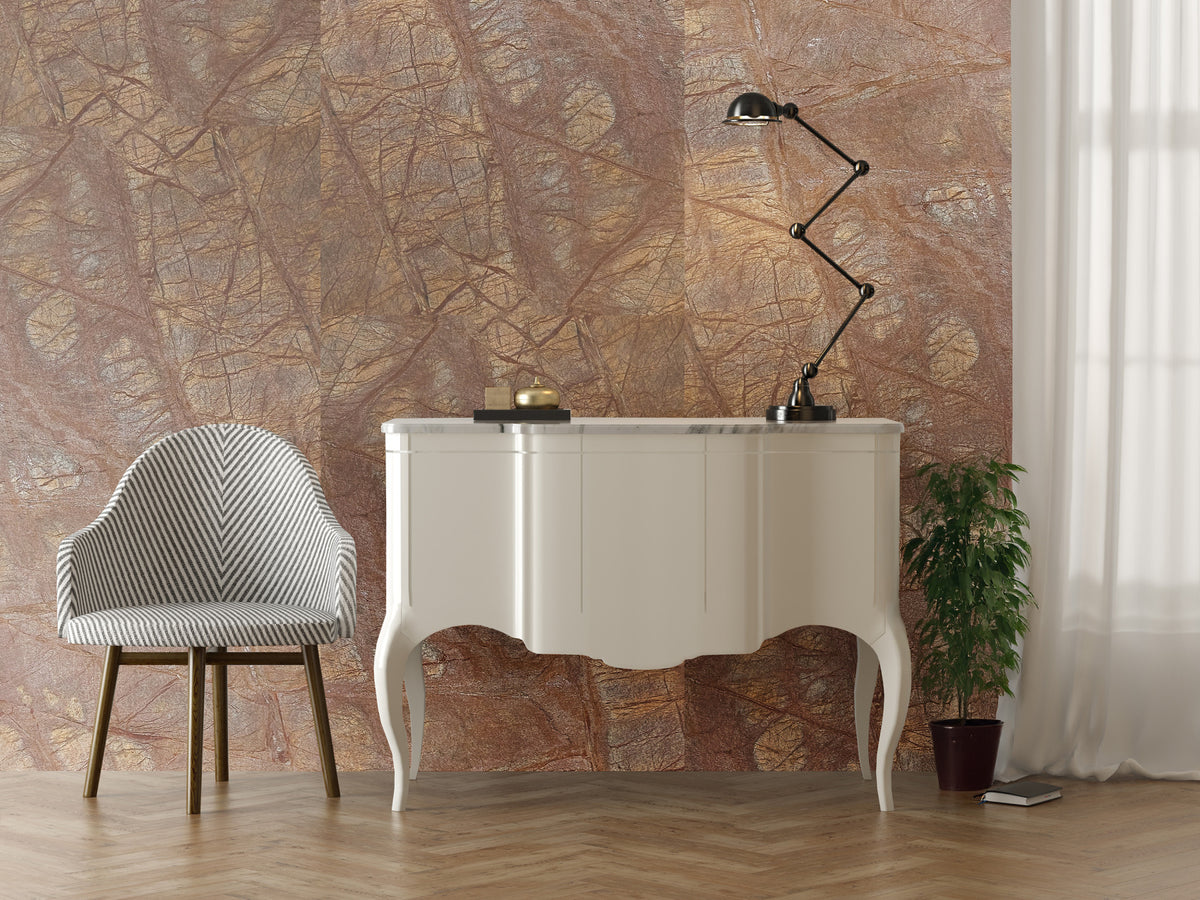
Our service
Do you offer your materials in different sizes?
Do you offer your materials in different sizes?
Yes. Our main range of slate and stone veneer is available in a standard 122 x 61cm sheet and a larger 240 x 120cm jumbo sheet. Our Multi Brick panels are 120 x 60cm, while our Split Face cladding pieces are 30.5 x 30.5cm.
Can I get samples of your materials?
Can I get samples of your materials?
Yes. Samples of our materials can be ordered directly through our online store, allowing you to see the natural colour, texture and finish of the material before placing a larger order.
Can you help me calculate how much material I need to order?
Can you help me calculate how much material I need to order?
Yes. Send us the dimensions or a rough sketch of the area you want to cover, and we can help calculate how much material you will need for your project.
Can I vist you to view your materials in person?
Can I vist you to view your materials in person?
Yes. You can visit us to view our materials in person, but visits are strictly by appointment. Please contact us in advance to arrange a suitable time.