



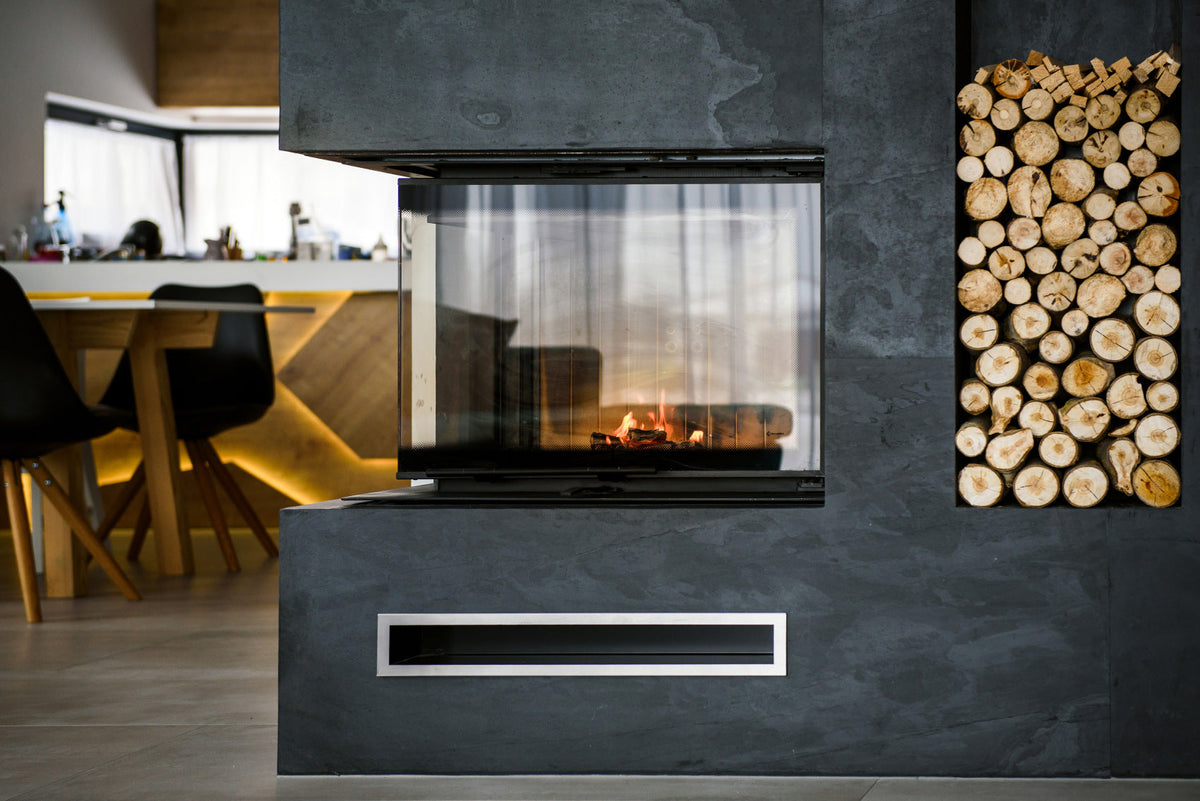
Can Stone Veneer Be Used Around a Fireplace?
Yes. Suitable natural stone veneer can be used around fireplaces to create a genuine stone surround or feature wall without the thickness and weight associated with traditional stone slabs or tiles.
Lite Stone slate and stone veneer is heat resistant up to 120°C and has achieved a Cfl-s1 fire classification. It can therefore be used for suitable fireplace applications where the surface temperature does not exceed 120°C.
As with any material installed near a heat source, the design and construction of the particular fireplace should be considered before installation.

Why Use Stone Veneer Around a Fireplace?
A fireplace naturally creates a focal point within a room, making it an ideal location for the colour and texture of natural stone.
Stone veneer provides a genuine natural stone surface in a thin, lightweight format. This allows a substantial-looking stone feature to be created without using thick and heavy stone slabs.
It can be particularly effective for:
Fireplace feature walls
Chimney breasts
Fire surrounds
Media walls incorporating fireplaces
Hearth areas where the particular application is suitable
Full-height floor-to-ceiling features
Because the stone is natural, every sheet has its own markings, colour and texture.
Is Stone Veneer Heat Resistant?
Lite Stone slate and stone veneer is heat resistant up to 120°C and has achieved a Cfl-s1 fire classification.
The temperature of the surface where the veneer will be installed should therefore not exceed 120°C.
It is important to distinguish between the temperature of the appliance itself and the temperature reached by the wall or surface onto which the veneer is being installed.
Fireplace designs, appliances and installation requirements vary considerably. If there is any uncertainty about the temperatures involved or the required clearances around a particular appliance, check the fireplace manufacturer's installation requirements before installing decorative cladding.
Can Stone Veneer Be Used Around a Wood-Burning Stove?
Stone veneer may be suitable around a wood-burning stove where the installation complies with the requirements of the stove and the surface on which the veneer is installed remains within the material's suitable temperature range.
Wood-burning stoves can generate substantial heat, so the distance from the appliance, construction of the surrounding wall and manufacturer's specified clearances all need to be considered.
Do not assume that veneer can be installed directly beside every stove simply because the visible surface is natural stone. The backing, adhesive, substrate and complete wall construction all form part of the installation.
Can Stone Veneer Be Used Around an Electric Fireplace?
Stone veneer can be particularly effective around electric fireplaces and media walls.
Electric fires are commonly incorporated into feature walls with televisions, shelving or cabinetry, and natural stone veneer can be used to create a contrasting surface around the fireplace.
The heat output and manufacturer's clearance requirements for the particular appliance should still be checked before installation.
Can Stone Veneer Be Used on a Media Wall?
Yes. Stone veneer can be used to create a natural stone finish on suitable media walls.
Its thin and lightweight construction makes it particularly useful for cladding larger feature areas without adding the thickness and weight associated with conventional stone.
Natural stone can be used across the complete media wall or selectively around the fireplace and television to create a focal point.
If a television, fireplace, lighting or other electrical equipment is incorporated into the wall, the complete construction should be planned before the veneer is installed so that access, ventilation and appliance requirements are taken into account.

What Surface Should Stone Veneer Be Installed Onto?
Stone veneer should be installed onto a clean, dry, flat and stable substrate suitable for the particular fireplace construction.
The substrate needs to remain stable under the conditions created by the fireplace.
Before installing the veneer, check that the wall is level and free from loose material, dust or contamination that could affect adhesion.
If the fireplace manufacturer specifies particular non-combustible boards, clearances or construction methods, those requirements should take priority when preparing the fireplace structure.
Preparing Stone Veneer for a Fireplace
Before fixing the veneer, lay out all the sheets that will be used on a flat surface.
Natural stone varies from sheet to sheet, so arranging the material beforehand allows you to decide how the colours, markings and patterns should flow across the fireplace.
This is particularly useful for floor-to-ceiling chimney breasts and larger media walls where several sheets will be positioned together.
Plan the locations of joints, corners, the fireplace opening, television, shelving and other features before cutting or applying adhesive.
How Do You Install Stone Veneer Around a Fireplace?
Once the substrate has been confirmed as suitable, measure the fireplace carefully and plan the position of each sheet.
Cut the veneer to the required dimensions before fixing it.
For most suitable slate and stone veneer installations, use an appropriate adhesive and apply it evenly to achieve good contact between the veneer and substrate.
Position the sheet carefully and press it firmly and evenly into place using a suitable float or roller.
Continue across the wall while checking the alignment and natural variation between neighbouring sheets.
Take particular care around the fireplace opening, corners and other highly visible edges.
For complete fitting information, see our Stone Veneer Installation Guide.
How Do You Cut Stone Veneer Around a Fireplace?
Slate and stone veneer can be cut using an angle grinder with a suitable tile blade, a multi-tool or a tile saw.
Measure and mark the material carefully before cutting, particularly around fireplace openings and other prominent edges.
If you have not worked with stone veneer before, practising on a sample or offcut can help before making important cuts to full-size sheets.

How Do You Finish Fireplace Corners?
External corners can be created by carefully butt-jointing the veneer sheets.
For a neater finish, masking tape can be applied along the stone edges before the corner is carefully sanded with suitable sandpaper to remove sharp edges and create a smoother transition.
Accurate cutting and alignment are especially important on fireplace surrounds because corners and edges are often prominent parts of the finished design.
Does Stone Veneer Around a Fireplace Need Sealing?
Whether sealing is required depends on the stone and the particular application.
Natural stone can be susceptible to staining, so a suitable natural stone sealer may be beneficial where additional protection is required.
If you want to retain the natural appearance of the material, choose an appropriate non-colour-enhancing natural stone sealer.
Always ensure that any products used as part of the fireplace installation are appropriate for the conditions in which they will be used.
Can Split Face Cladding Be Used Around a Fireplace?
Yes. Lite Stone split face cladding can also be used around suitable fireplaces.
Split face cladding creates a very different appearance from stone veneer. Rather than a relatively flat stone surface, the individual pieces project at different depths to create a strongly textured three-dimensional finish.
This can make split face particularly effective for traditional-looking fireplace surrounds or feature walls where a deeper, more rugged natural stone appearance is wanted.
For more information, see our Split Face Cladding Guide and Split Face Cladding Installation Guide.
Stone Veneer vs Split Face Cladding for a Fireplace
Both materials provide a genuine natural stone finish, but the visual result is quite different.
Stone veneer is thin, lightweight and relatively flat. It works well for contemporary fireplaces, large feature walls and media walls where keeping additional thickness to a minimum is useful.
Split face cladding is thicker and much more textured. Its uneven natural stone surface creates stronger highlights and shadows and can give a fireplace a more substantial stone appearance.
The best choice depends on the style of the room, the construction of the fireplace and the type of finish you want to achieve.
Choosing Stone Veneer for a Fireplace
Consider the fireplace together with the other colours and materials in the room.
Natural stone with strong colour and markings can turn the fireplace into a dramatic focal point, while a more restrained stone can add texture without dominating the space.
Lighting also affects how the stone appears. Directional lighting can emphasise the natural texture, while daylight can reveal variations in colour across the sheets.
Ordering samples allows you to compare different stones beside flooring, furniture, paint colours and other finishes before choosing the material for the complete fireplace.
Fireplace Stone Veneer Ideas
Stone veneer can be used in several ways depending on the style of the room.
A floor-to-ceiling stone feature can emphasise the height of a chimney breast, while cladding only the area immediately surrounding a fireplace can create a more restrained focal point.
Stone veneer can also be incorporated into contemporary media walls alongside televisions, cabinetry and lighting.
In larger rooms, natural stone can provide useful contrast against painted walls, timber, glass and other smooth surfaces.
Our Project Gallery includes examples of Lite Stone materials used on fireplaces, media walls and feature walls in completed projects.
Explore Stone Veneer for Fireplaces
Natural stone veneer can transform a fireplace into a distinctive feature while providing the colour, texture and individual character of genuine stone in a thin and lightweight format.
The particular fireplace, heat source, substrate and manufacturer's requirements should always be considered before installation.
Explore our Slate & Stone Veneer collection to compare available finishes and order samples, read our Stone Veneer Installation Guide for detailed fitting information, or visit our Project Gallery to see Lite Stone materials used in completed fireplace and feature-wall projects.


